How to Read a Forest
Spending time with a forest can feel like reconnecting with an old friend.

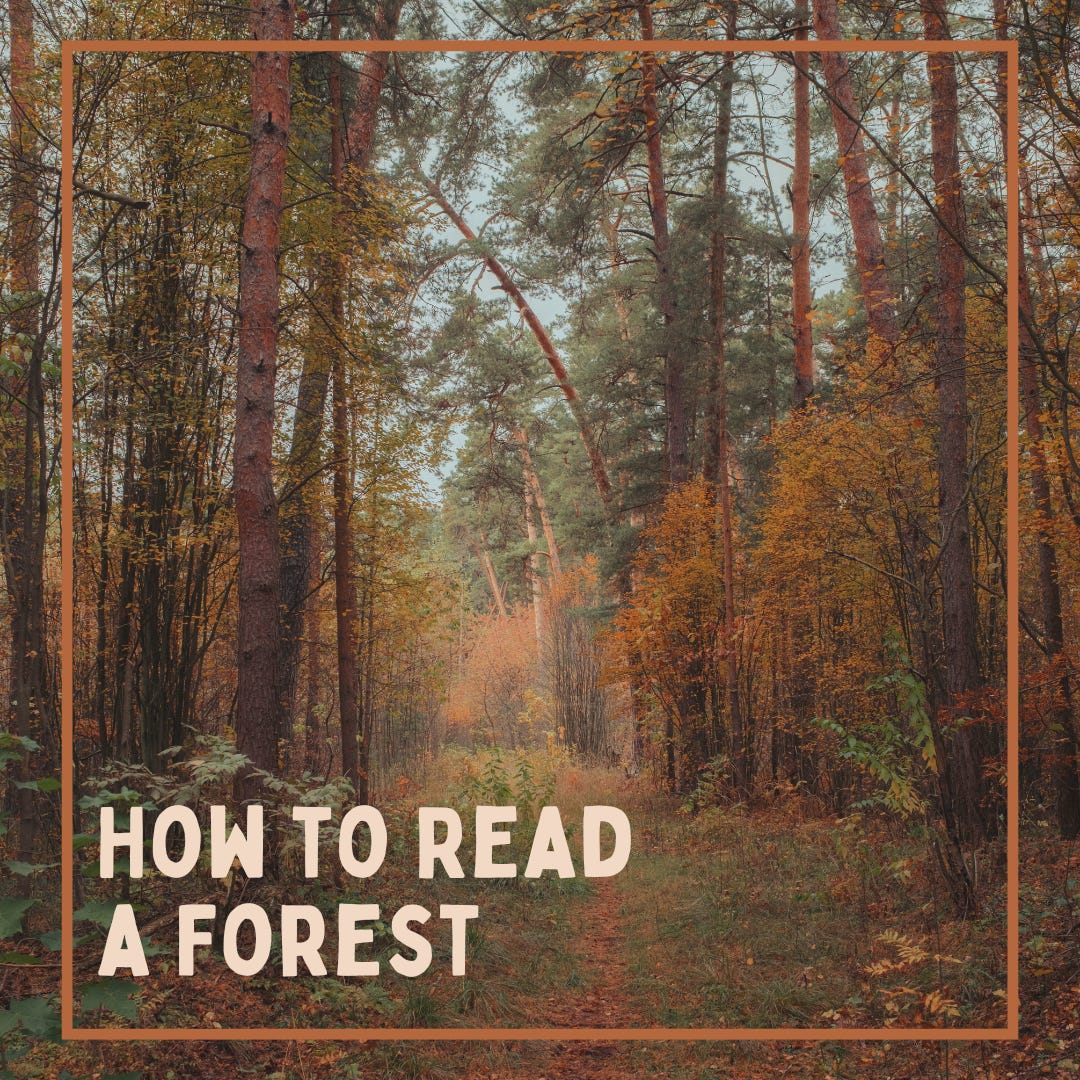
The leaves carpeting the forest floor have turned crispy and brown in the late autumn heat. So many, they bury the path that weaves and bends in sync with the river. The crinkle and crunch of leaves underfoot is a welcome sign of autumn in our midst; I don’t know anyone who doesn’t love that sound. Without any wind and with fewer birds enlivening the canopy with their songs this time of year, the sound of leaves crunching is doubly conspicuous. I shuffle along, careful to avoid roots and rocks hidden beneath the featherweight leaf-mat.
The day is warm, and the forest is bathed in a golden light that’s filtered through yellow maple leaves. So yellow that the color seems born of something delicious and intensely edible: tropical mangoes and bright tangerines; sweetcorn and the rich, creamy butter we spread over it. Blue sky peeks between still branches. Kinglets alight on twigs high in the canopy, twittering and twinkling, before moving on. Brown Creepers and nuthatches scale the trunks, heading in opposite directions, one up, the other down. The trees are spaced far enough apart that I can see the earth’s undulations, low kettle hills, created thousands of years ago by retreating glaciers, rolling gently over the landscape. I walk for hours, encountering no other people. To me, solitude is not lonely or frightening. Alone, I am calm. In a forest, I feel tranquil.
I have met walkers who are fearful of forest paths, like this one, too uncertain of their inner compass to leave the well-paved sidewalks. Even in urban parks, where the woods barely conceal linear rows of homes and offices and cannot diminish the sound of traffic and leaf blowers a few blocks away, many people dare not enter. We are evolutionary conditioned to fear what is unfamiliar, avoid places where unseen dangers may lurk, and shun what we do not understand (though that’s not to say we shouldn’t take sensible precautions by carrying maps, water, and appropriate clothing when venturing outdoors).
So, in my ongoing effort to connect people with the natural world wherever they live, I think it can be worthwhile to facilitate an introduction, to help newcomers learn how to read a forest so that instead of feeling lost or disoriented, spending time with a forest feels like reconnecting with an old friend.
The first thing to know about forests is that there are many different types, and they look different depending on where you live. Each forest type hosts different plants and animals, which means that by getting to know the species that live there, and learning to recognize signs that hint at the age of the forest, we can become more familiar with—and less fearful or judgmental of our surroundings when we are out in nature.
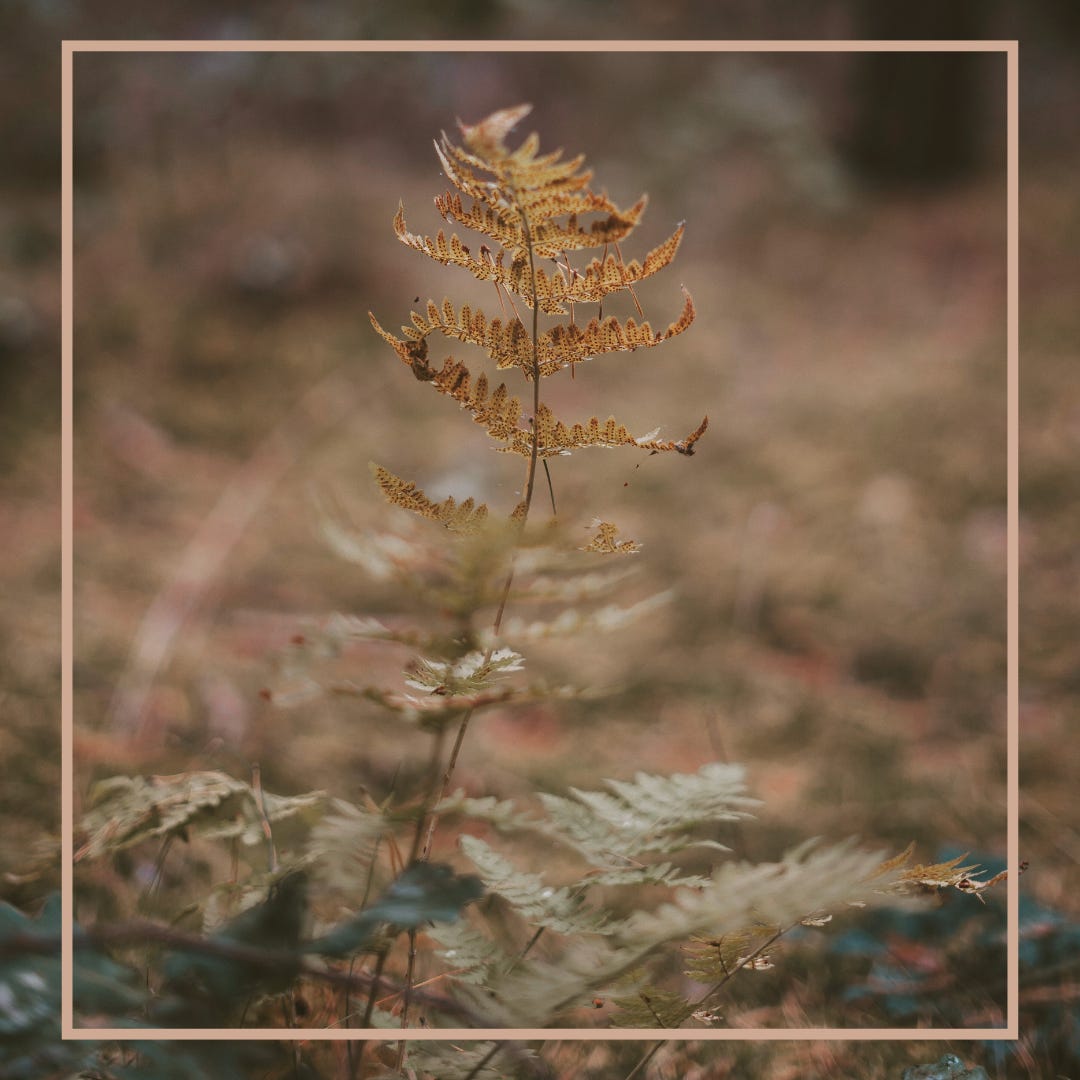
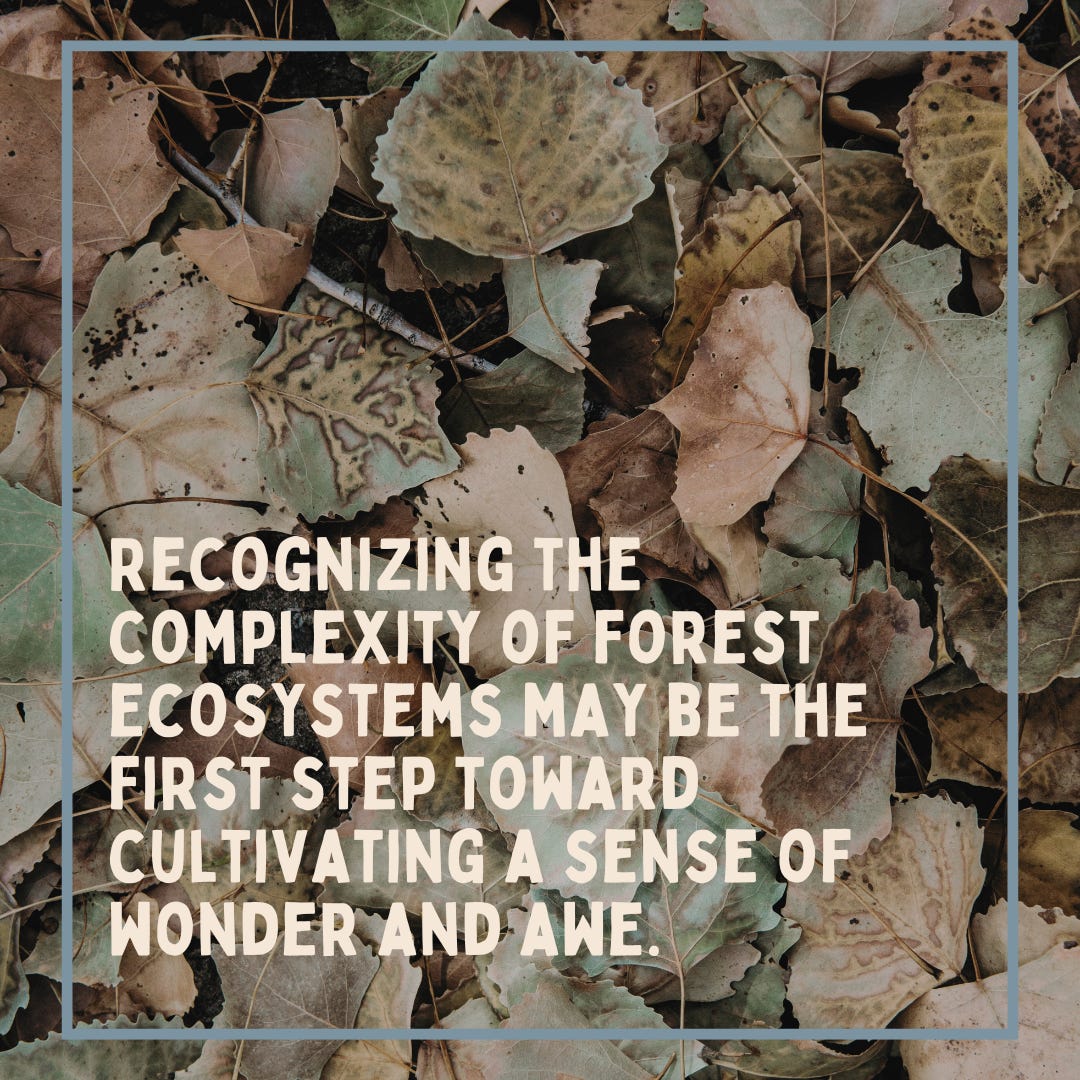
It may seem obvious, but the primary characteristic of a forest are the trees—contrast this to a prairie, savannah, desert, or certain kinds of wetland habitats, which naturally have fewer trees and appear more open. Therefore, one of the first ways to begin to read a forest is to learn to identify the trees as individuals: by their leaves and bark, initially, and later by their buds, branch structure, even their deadwood. Autumn is a wonderful time to learn to identify trees because you can match the leaves you find on the ground to the tree they came from. It is helpful to have a guide, a book or a friend or even a mobile app that can help you differentiate one from another. But it can be equally useful to simply pay attention and begin to recognize which leaves match the bark of which trunk and which species of trees grow together, whether you know their names or not. With attention, patterns and kinships among species emerge: Paper Birch with its peeling, pearly white bark often grows alongside White Cedar; or that aspen groves often grow up near the edges of more mature woodlands, forming stands that appear to be made up of individual trees but are actually a single clonal organism. Some forests will have only leafy deciduous trees, like maple, beech, and ironwood, that lose their leaves in autumn, while others have many coniferous trees, like pine, spruce, and hemlock, that hold their green needles all year.
The age of a forest is also key to understanding its place in the community as well as the health of the ecosystem it supports. In North America, there are few areas of the continent that remain untouched by colonial and industrial development (which differs considerably from pre-colonial Indigenous land management). At one time or another, almost every forest in this country was converted over to agriculture. Even the seemingly primordial forests on the East Coast, such as those hugging the Appalachian Mountain belt, were once farmland; look closely and you might notice stacked stone walls in the middle of the woods indicating abandoned farmland. (Note: that is not to say that the Northeast does not offer stunning examples of forest restoration.) Consequently, intact pre-colonial Old Growth, or virgin, forests are vanishingly rare. Very few forests or even individual trees in this country are more than a few hundred years old.
Telling the age of a forest is a tricky business, but there are ways for casual visitors to estimate. Most of us know that old trees are big—tall and wide (though there are exceptions to this rule, such as in harsh and nutrient-poor landscapes, like rocky cliffs and bogs). This is due to the trees’ natural growth pattern, in which rings of cells grow outward each year, like a belly expanding with age. Famously, these rings can be viewed in cross section when a tree is felled; each ring indicates a year of growth. The wider apart they are, the more water and nutrients the tree was able to consume that year; narrower growth rings indicate a lean year. Among the oldest are the Giant Sequoias in the American West (outlived only by bristlecone pines and Alerce trees in Chile). A very few remaining individuals are over 3,000 years old, born when Ancient Egypt and Babylon were in decline, while the Kingdom of Israel, under King David, entered a golden age, establishing Jerusalem as its capital.
You can learn a lot about the history of a forest by the relative ages and girths of its trees. If all the trees in the forest are narrower than a baseball bat, and are growing close together, that indicates a very young forest, likely one that grew up after a clearcut. A healthy, mature forest has trees of all different ages, heights, and species. Diversity and structural complexity promote stability by fostering a habitat where thousands of species of insects, fungi, birds, and mammals interact and thrive. Conversely, homogeneity is fragile and will topple easily—in the case of a blight, for instance. Homogenous forests tend to be utilitarian.
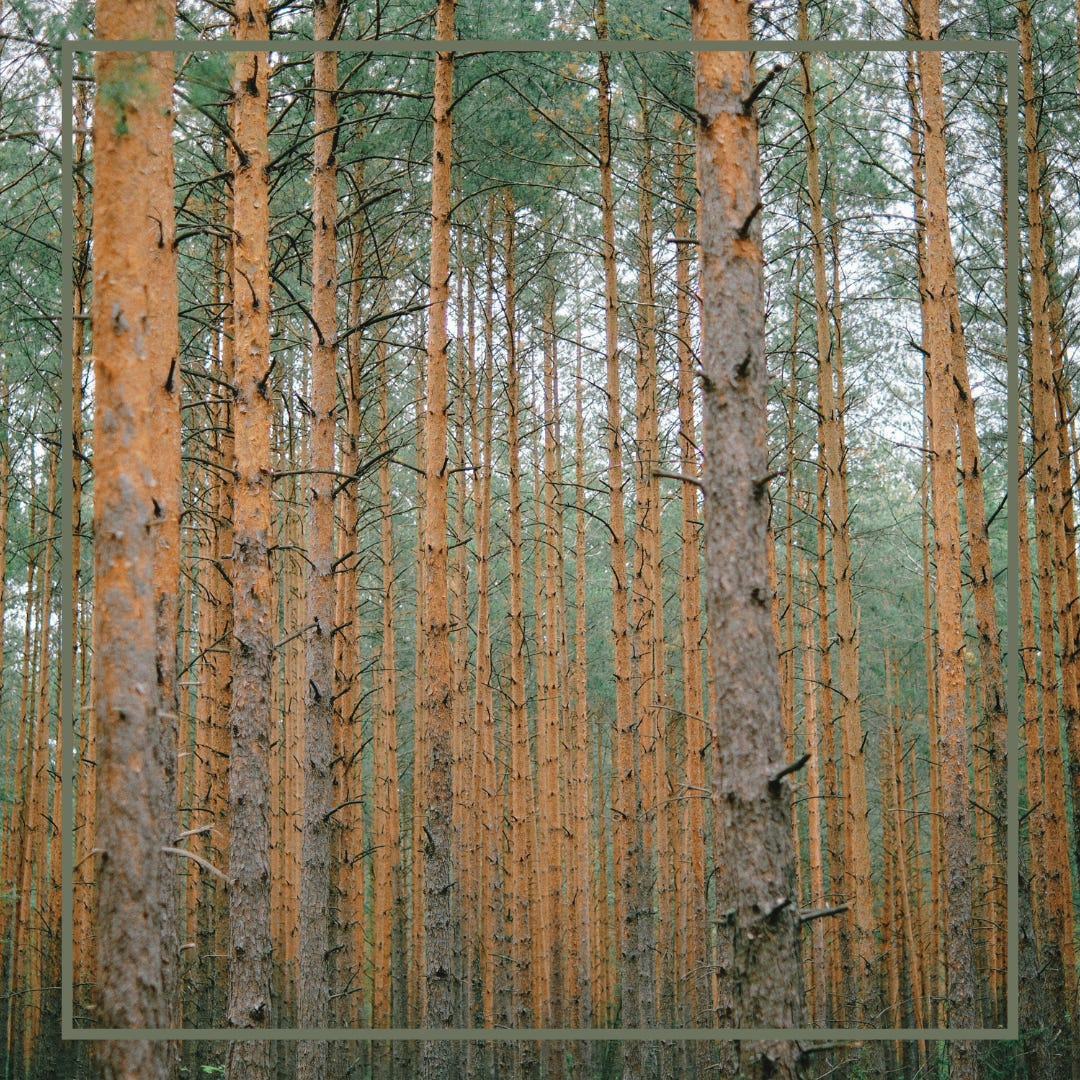
I keep walking and suddenly the sensation underfoot changes to a soft cushion of pine needles. I am surrounded by rows of pine trees which all appear to be about the same height, width, and age. All the lower branches have been uniformly trimmed. Their bark has undertones of brick red, and the resiny scent of pine is strong, but I hear very little birdsong, only an occasional chick-dee-dee-dee-dee. These rows indicate a forest planted for logging and timber production. Notice the forest floor in these wood lots. Listen. They will often be very quiet, lacking birdsong and insect noises, and will feel quite bare because these uniform, standardized forests harbor much less wildlife, including understory plants.
Removing trees is not necessarily bad thing. Thinning the woods selectively can improve forest health by creating gaps in the canopy to let more light reach the forest floor and by giving the selected trees that remain more room to grow. Responsible foresters and land stewards will choose carefully and leave sentinel Mother trees—the oldest and most mature—to colonize the next generation, bearing the weight of genetic diversity for other species as well as their own. Meticulous stewards will also take care not to overly disturb the forest floor, for it is not the trees themselves that necessarily give the clearest indication of forest health, but the woodland plants that grow low to the ground. Maidenhair ferns, with their arc of lacy tendrils; wild columbine with its intricate red and yellow flowers that sway gently on slender stems; bottlebrush grass, with its unique alternating seeds; and hundreds more.
Where I live, in the Great Lakes region, many spring ephemerals will emerge and blossom before any leaves dapple the shrubs and trees, taking advantage of the weak sunlight before they’re shaded out by taller plants. Among the brown leaf litter of rich deciduous forests, you can occasionally find immense colonies of white trillium and bloodroot, the blue and pink blossoms of Virginia bluebells, or the nodding yellow flowers of trout lilies. Delicate violets, Spring Beauties, hepatica, and Dutchman’s breeches tend to stake out individual sites, but are no less rejuvenating for winter-weary people and pollinators, alike. Unfortunately, these rare beauties are fragile and susceptible to disturbance. Many rely on ants for seed dispersal and cannot migrate fast or far, like seeds dispersed on the wind. Once removed from a landscape, they rarely return. Their absence in a forest indicates human carelessness and reckless deterioration of biodiversity. Learning to recognize and identify these tiny, overlooked flowers sparks joy in the earliest months of spring. Mosses and lichens, too, are slow colonizers. It can take decades for these beings form a dense mat or coral-like cluster over boulders and deadwood.
Learning which trees grow in which conditions can also reveal something about a forest. Finding a very large, mature White or Bur Oak—two sun-loving species—in the middle of a woodland likely indicates the land was not a forest within the last century or so. You might even stumble upon an entire row of mature oak trees in a forest, often near a stacked stone wall, indicating a former property border or edge of what was one a farm field. Occasionally, I’ve found myself deep in what feels like untouched woodland, only to stumble upon a piece of ancient farming equipment, little more than a frame of rust. Similarly, the presence of nonnative species like Norway Spruce—brought to America from Eurasia—usually indicates someone planted an ornamental grove or windbreak in the past.
It may come as a surprise, but another indication of a healthy woodland is a “lumpy” forest floor. Where trees have fallen, decaying trunks remain, often for decades, offering the nutrients of their bodies back to the earth. Often these small undulations will be blanketed over by mosses, leaves, or small leafy plants. Sadly, even the world of decomposition is under threat thanks to the humble earthworm, a nonnative species introduced from Europe that accelerates decomposition faster than our native species can adapt. (They also cause a whole suite of other problems, from disrupting seed germination to interrupting mycorrhizal networks). The presence of abundant deadwood on the forest floor, covered over by a healthy diversity of understory plants, may indicate an absence of earthworms.
I believe in the power of wonder to inspire care. Recognizing the complexity of forest ecosystems may be the first step toward cultivating that sense of wonder and awe. By learning to recognize the characteristics of a healthy forest, we may begin to notice when these ecosystems deteriorate, whether by direct human action or inaction, by invasive species invasion, or by our heating climate. By spending time with these places, consistently, over seasons, we can recognize change when it occurs. That isn’t to say we must bring our judgments along to these places; if anything, the imposition human will, ideals, or programs on the natural landscapes should proceed with caution and, more importantly, reverence.
As the sunlight dims and the autumn forest sinks into dusky shadow, I hear the call of a great horned owl. Deep in the woods, untamed, a wild spirit sings.

I resonate, that 'edible' yellow light. So goood.
How to Read a Forest is another beautiful and poignant piece. I particularly love the last two sentences, for personal reasons.