

Plant Heaven
The interlocked rhythms of wild lupine and the Karner blue butterfly.

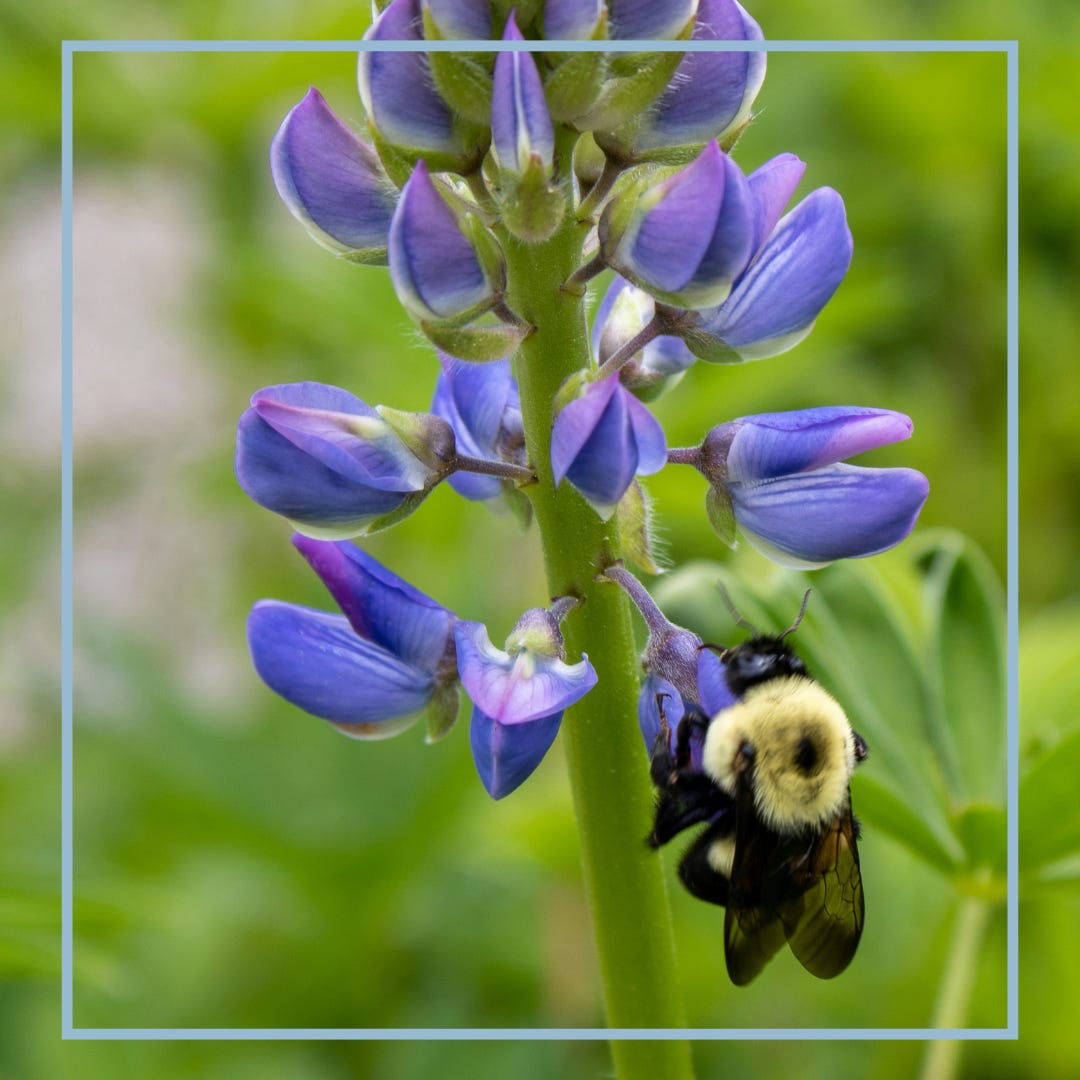
I see them from afar, a pale wash of purple blooms painted across the dry, sandy savannah: a rare abundance of wild lupine. Blue sky above, violet-blue all around me, and beyond the stands of mature black oak and rolling dunes, off in the unseeable distance, the shush and roll of blue-gray Lake Michigan. Though we see the color blue virtually every day overhead, like a glazed ceramic bowl upturned, it is among the rarest colors in nature, for blue pigment is almost nonexistent in living organisms.
Blue pigment absorbs all light wavelengths except blue but is susceptible to fading over time as the chemical structure degrades. In contrast, structural blue—the blue of a jay’s feathers, the powdery hue of a Karner blue butterfly, and the petite blue-eyed grass flowers dappling this unique prairie ecosystem—is a physical phenomenon where microscopic, repeating structures reflect only blue wavelengths of light, essentially acting as light-scattering prisms. Structural blue is dependent on the viewer’s angle, creating an iridescent or metallic sheen as the physical structure shifts and moves. According to Natural Wonders, it is too molecularly complicated for organisms to create the structures needed to produce actual blue pigment. “Evolutionarily, it’s easier to tweak other pigments or trick the eye with structural color.”
I walk amid stands of widely spaced oaks, their canopies spaced far enough apart to allow plenty of sunlight to reach the earth. And here, the earth is a tapestry of flowering vegetation.
Wild lupine (Lupinus perennis), with its purpley-blue-and-white pea-like flowers and sundial bursts of leaves, is an indigenous perennial plant that prefers sand, wind, and sun, conditions Illinois Beach State Park (IBSP) has in abundance. Magenta-colored prairie phlox and tangerine orange hairy puccoon, splashes of color amongst the conically shaped lupine, are so ostentatiously bright that you could be forgiven for thinking these are ornamental cultivars.
Here on the western shores of Lake Michigan lies one of the most ecologically rich parcels of remnant, pre-colonial habitat, including the largest unplowed sand prairie in Illinois and fourteen other distinct and/or globally rare eco-communities. It is such an ecologically important place that immense care and attention is given to preserving its health, in part by removing any non-native plants that shouldn’t be here.
To a trained eye, the oak savannah is among the most dazzling landscapes on the continent. The park’s discrete, layered ecological zones serve as a textbook example of ecological succession. A satellite or drone view reveals distinct striations, visible stripes on the landscape moving east to west, away from the lake. Pioneer plants on the dunes adapt to harsh winds and shifting sands, gradually transitioning into stabilized sand prairies colonized by succulents and grasses, and eventually black oak savannas as humus builds in the soil. Being here is like looking into the past, one we have nearly erased for the sake of chemically managed and environmentally purposeless lawns, corporate big box stores, and acres of asphalt.
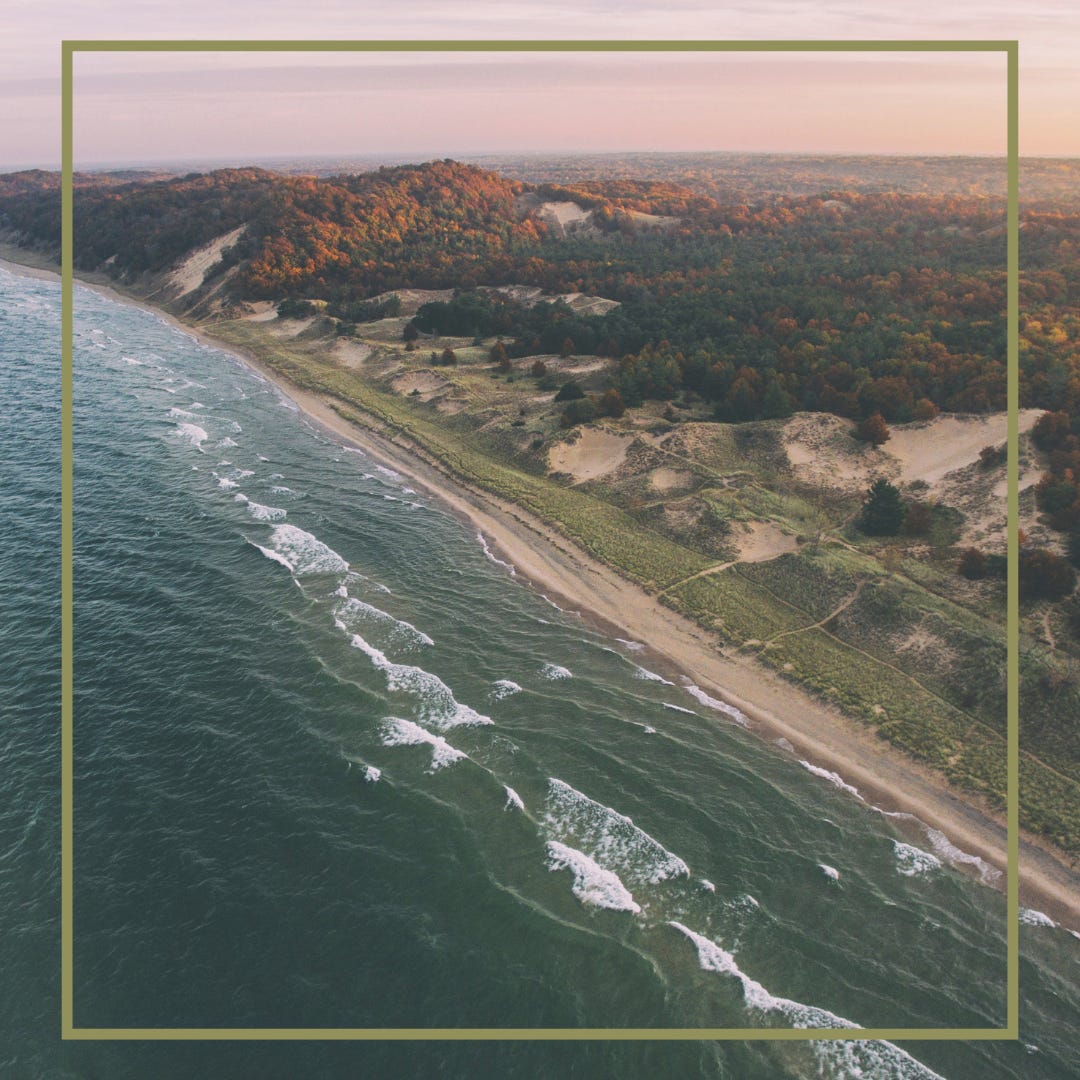
this is actually a photo of Holland, MI—I couldn’t find an aerial image of IBSP! the gradation is similar, based on images from the IBSP nature center
Because of its early flowering time, lupine is favorite of overwintered Queen bumblebees, mason bees, and miner bees. The irregular form of this flower might confuse a human eye—how do they enter?—but these hovering insects have no difficulty prying apart the petals using each of their little legs to get at the pollen inside. Wild lupine’s most sacred role, however, is reserved for the Karner blue butterfly.
This fragile butterfly is a dusky, silvery blue accented with black dots and a painterly wash of orange crescents along the outside rim of the wing. No larger than a postage stamp, the Karner blue travels less than six-hundred feet in its lifetime, remaining close to its host plant: the wild lupine, the only species on which it can successfully lay its eggs. Although adults can drink the rich nectar of many flowers, the Karner blue caterpillars feed only on the leaves of the wild lupine (Lupis perennis) plant, and no other. Similar to the Monarch butterfly’s complete dependance on milkweed for reproduction, the Karner blue is entirely reliant on wild lupine.
Due to habitat loss, fire suppression, and displacement by ecologically purposeless ornamental plants, transcontinental transplants out of sync with local cadence, and the highly invasive western Bigleaf lupine (Lupinus polyphyllus), Wild lupine has become locally extinct or is endangered/threatened across much of its native range. Karner blue butterflies once occurred in a nearly continuous band across twelve states and the province of Ontario, Canada—wherever wild lupine thrived in dry, sandy soils surrounding the Great Lakes. But the elimination of its host plant, its incompatibility with bigleaf lupine, and fragmentation of its habitat has eliminated this marvelous insect from everywhere but slim portions of only a few states.
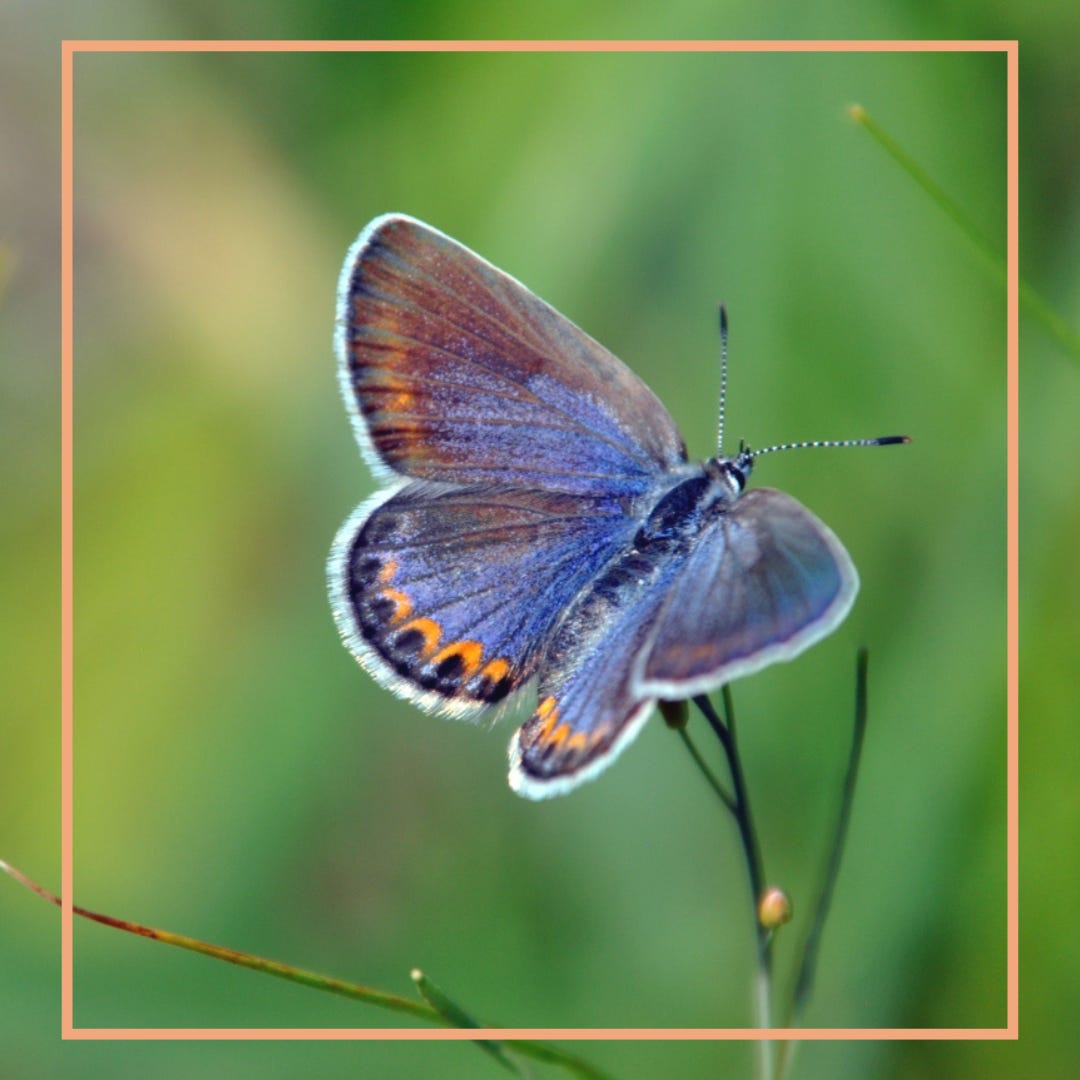
photo credit: female Karner blue butterfly, Jill Utrup/USFWS
Intact ecosystems like this one, at Illinois Beach, demonstrate how the pieces of a habitat fit together and rely on one another, a hoop of symbiotic relationships. Like an evolving conversation, these relationships were refined over millennia, an orchestra of specializations and adaptations that resulted in the music of biodiversity we see today. But specialists, like the Karner blue and its partner, wild lupine, are not genetically adapted to tolerate abrupt change or a rapidly evolving climate.
Every May, I return to this place just in time to view the profusion of lupine. In years to come, I may have to adjust my timing, nudge my visit a few days or weeks earlier to coincide with plants’ responses to altered seasons. It is an unfortunate fact that the Karner blue butterfly has not been seen here in recent decades. A similar landscape at Indiana Dunes State Park used to host a healthy population, but due to unseasonably warm winters the overwintering insects emerged too early, before the lupine, and the entire colony perished in a single spring. The butterfly is considered locally extinct now in both Illinois and Indiana.
Yet the effort to save these remarkable species is not lost. State-based work to expand lupine habitat and maintain the high quality, sparse undergrowth it needs to survive are underway in New York and Wisconsin. Individuals can help, too, by choosing to plant regionally adapted species at home over hothouse cultivars that may be beautiful to look at, but have no ecological relevance to the landscape.
Flowers are easy to love and admire because they are beautiful, but they become even more precious, unique, and interesting when we take the time to understand their role in an ecosystem, who their partners are, and how they are adapted to survive.
According to botanist and essayist, David George Haskell, in his magnificent ode to Wildflower Beauty and the Search for Home, “Celebrating wildflowers is not an anesthetic—attentiveness reveals loss as well as beauty—but a grounding in the world as it is. Because flowers so entrance our senses, they offer memorable lessons, reorienting us back to the living Earth.”
For additional trail walk-throughs and photos of IBSP’s unique habitat, I recommend visiting this website: Nature in Chicagoland.
If you want to see the world with new eyes, I invite you to join me on my weekly rambles here on Substack, where I share my field notes, observations, and quiet reflections on nature and our place in it.
See you in the comments section!
Cheers,
Emily The Outsider
I write books about people’s connection to the land where they live and learning to connect with nature, often for the first time.
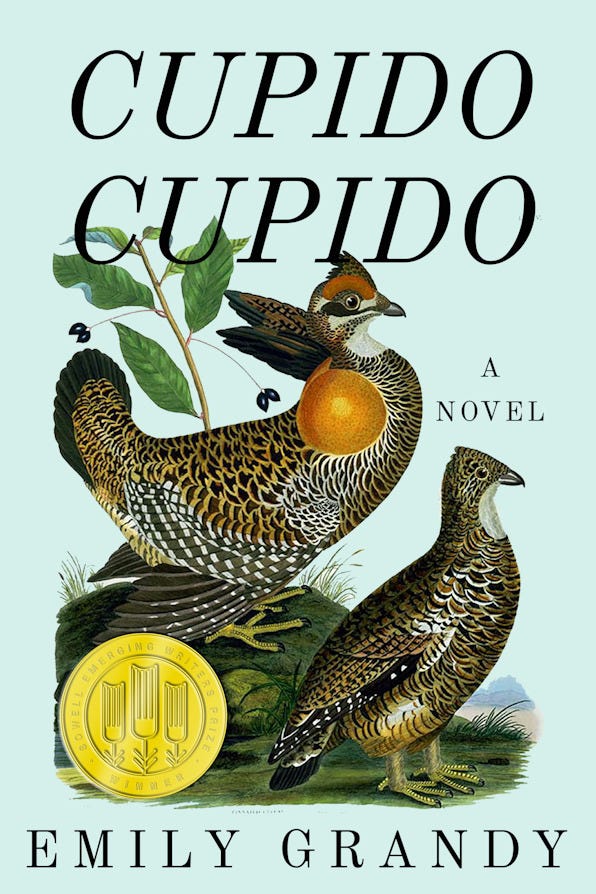
“Cupido Cupido is quietly affecting, the kind of novel that slowly builds emotional weight until you’re completely pulled in. What appears at first to be a familiar coming-of-age setup unfolds into something far more resonant: a meditation on cultural inheritance, ecological intrigue, and the painful intimacy of family silence.” —Goodreads review
Thanks Em. I've sent this out to all my friends.
Loved Plant Heaven! I did not know Lupine grew in your area! I had only seen it in the mountains in Colorado! I always learn something from your essays!