

Imperfect is Perfect
It is enough to be here and care just a little.

You do not have to be good.
You do not have to walk on your knees
For a hundred miles through the desert, repenting.
You only have to let the soft animal of your body
love what it loves.
Tell me about despair, yours, and I will tell you mine.
Meanwhile the world goes on.
Meanwhile the sun and the clear pebbles of the rain
are moving across the landscapes,
over the prairies and the deep trees,
the mountains and the rivers.
Meanwhile the wild geese, high in the clean blue air,
are heading home again.
Whoever you are, no matter how lonely,
the world offers itself to your imagination,
calls to you like the wild geese, harsh and exciting --
over and over announcing your place
in the family of things.
—Wild Geese, by Mary Oliver
Mid-May, a windless sunrise, and the maple forest is awash in birdsong. More than a dozen different calls beckon me from the trailhead. More than I expected on such a chilly spring morning. As I turn the first bend in the trail, the sound of commuters whizzing toward work and responsibilities fades by degrees. The birdsong intensifies.
The grass, still damp with dew, sparkles in the sunlight. A Wood thrush’s flute-like music wafts toward me from deep inside the forest. But it is the trilling and chirping of the newly arrived warblers I’m most drawn to today. I admire, not for the first time, the resiliency of these tiny migrants. Millions of them pass us by, virtually unnoticed, during these weeks of spring migration. They fly all night then touch down here, in a small neighborhood woodland along the Lake Erie coast, to rest and refuel before setting off again. Most are no bigger than the palm of my hand, yet they will travel thousands of miles before they reach their destination, from Central and South America to the boreal forests of Northern Canada.
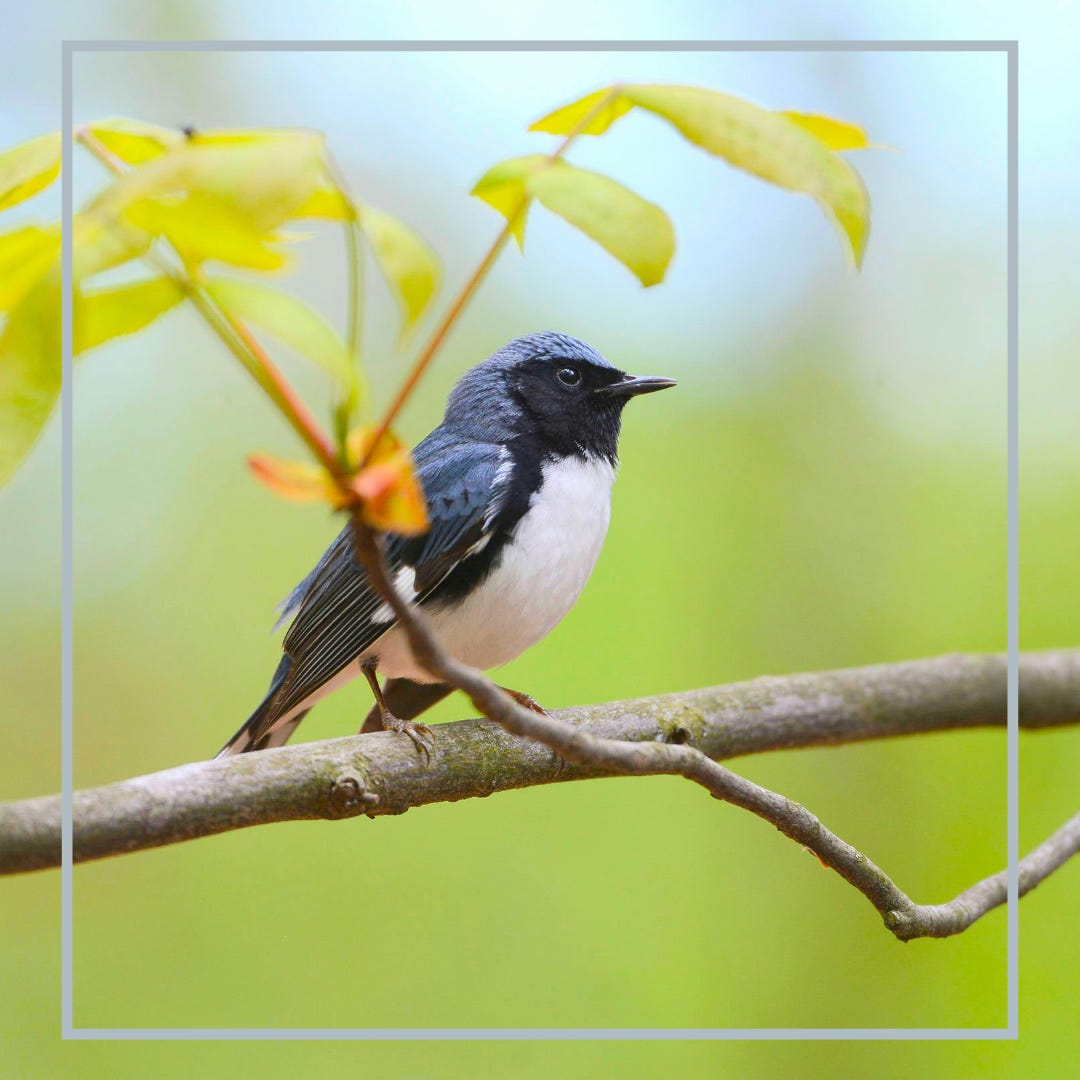
May in Ohio is affectionately known as warbler season. Warblers are among the smallest and most colorful birds, perching like little ornaments on the newly greening trees. Imagine glowing goldenrod yellows. Indigo blues. Masks of pure black. A shock of orange. It is a treat for the senses to go out in search of these tiny, life-affirming birds. During peak migration, they can be found anywhere there is habitat. But that doesn’t mean they will be easy to spot.
I crunch along the newly laid gravel trail, pausing from time to time to listen. There are approximately 35–45 species of warblers (family Parulidae) that breed in or regularly migrate through eastern North America. Each has its own unique individual call, but on days like this one the songs overlap and it takes a practiced ear to tease one from its neighbor.
The ascending zipper call of the Northern Parula.
The “wheezy, wheezy, wheezy,” squeaky wheel song of the Black-and-white warbler.
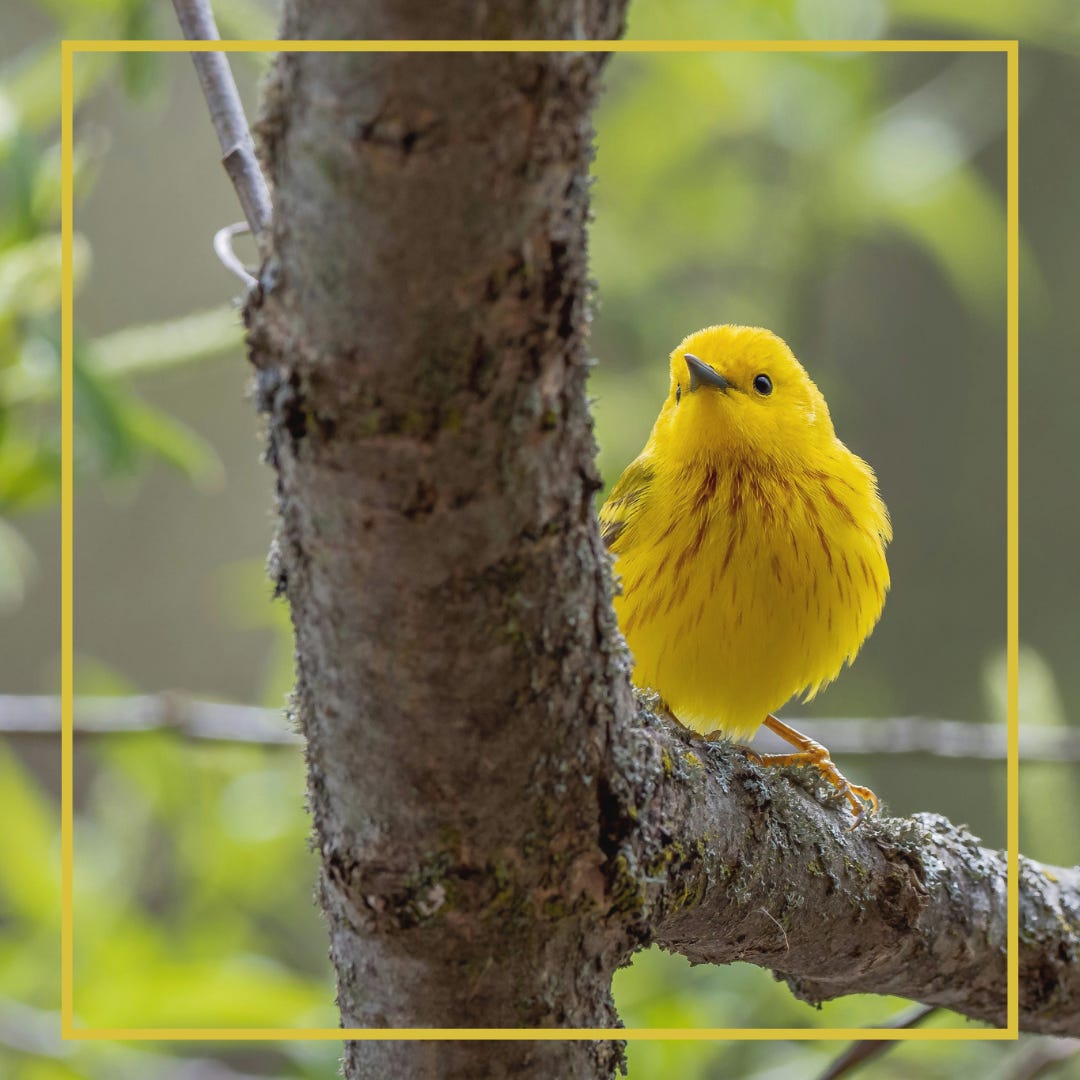
The Yellow who says, “sweet, sweet, I am so sweet,” usually from a nearby patch of shrubbery.
The Chestnut-sided goes, ““please, please, pleased to meet’cha.”
I note down who I’m hearing, but the upper branches where most are foraging are too distant to view, even with binoculars. No matter. As the early golden sunlight warms my hands and face, I simply enjoy this rare cacophony. A symphony you can only enjoy in spring.
The stands of trees reach twice as high as any house in this neighborhood and have been here twice as long. Oaks, basswoods, and maples whose girths are so broad it would take two adults, maybe three, to reach all the way around. Newly blossoming Mayapples cluster like little green umbrellas propped open near their roots. Virginia creepers twirl vertically up the trunks. Pale Jack-in-the-pulpit cups stand erect amongst the loam and leaves. Up high, in the uppermost branches, the birds are still singing.
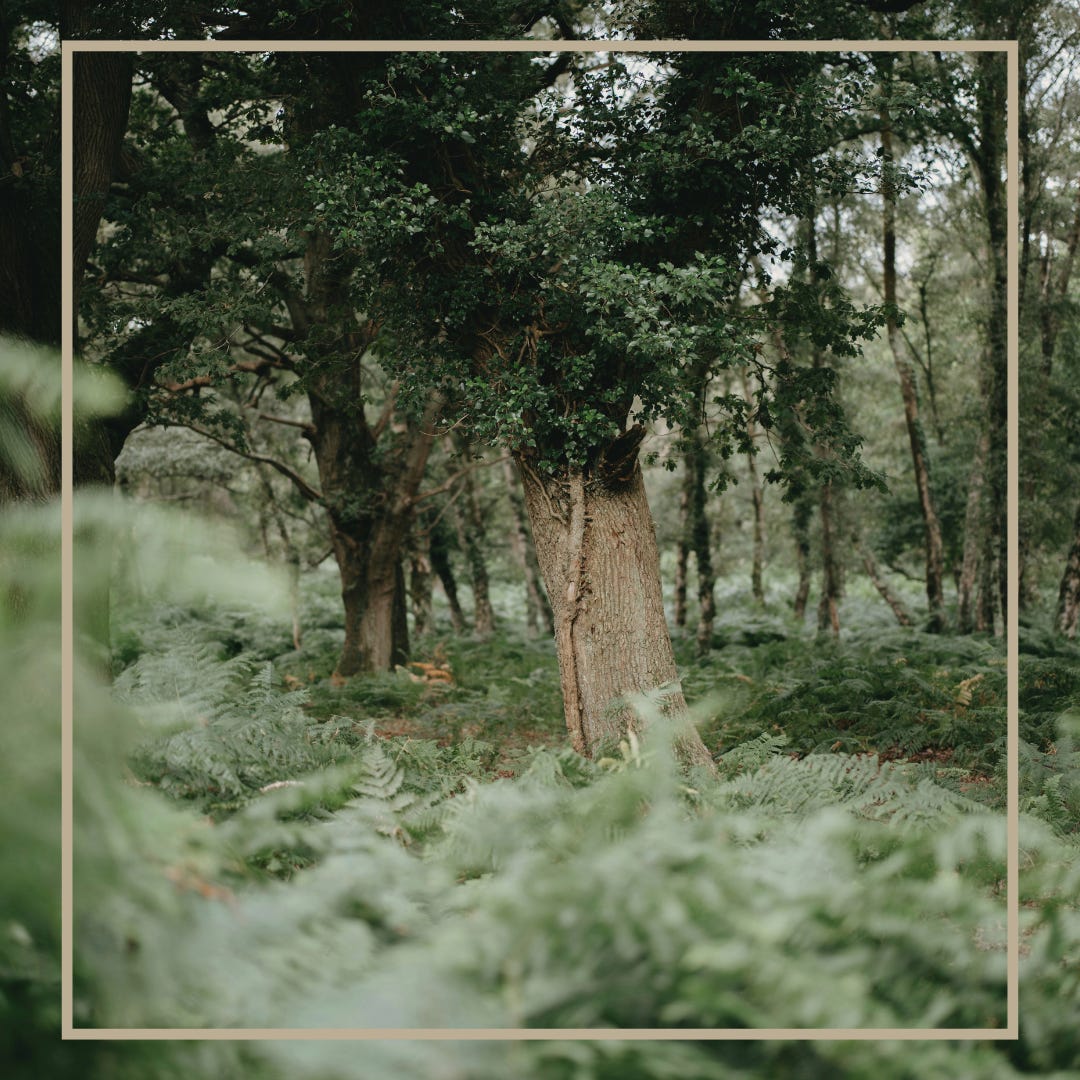
Until recently, these woods were inaccessible to people, though the birds found this place easily. By some unusual turn of events, a new trail and official county park designation was added across the road from one of my all-time favorite places to roam, walk, and go birding—a well-tended park encompassing high-quality woodlands, marsh, and grasslands. The confluence of three habitats attracts a higher diversity of species, especially birds. Given the density of new housing all around it, it is a literal refuge, both for people and wildlife.
In a highly developed county like this one, it is rare for decision-makers to add publicly accessible land. When seemingly every woodlot and un-mowed field sports a billboard advertising a new “development opportunity”, it came as a welcome surprise—and no little relief—to find one mature parcel of forest set aside not only for human recreation but for habitat. I don’t know the story of this place, whether it was an existing public land holding they finally found the money to manage, whether it was a recent acquisition thanks to a land trust, or whether it was a vocal community that swayed a disastrous development deal. For now, I’m simply grateful that hundred-year-old oaks, shagbarks, and maples can continue stretching toward the sky, reaching out to hold the birds.
These sorts of places desperately need our attention.
If we do not care that woodlots are disappearing and being replaced by fast food chains and corner drug stores and cheaply made housing complexes, then we lose the birds who need them as stopover habitat.
If we mow the little grassland wedged between one industrial complex and another, we lose the insects who sustain an entire local ecosystem.
We need to recognize that even degraded habitat is better than none at all.
We have used, abused, and butchered the land to suit our own ends, driving countless species towards extinction. Every place on earth needs people to stand against the status quo and demand restraint. It is no longer simply a moral imperative, but an ecological one. We are quick to forget that we lose not only beauty when we pave over every surface, we lose our own life support, too. Nature sustains us in both a physical and spiritual sense. When we defend her by lending our care, attention, our voices, our energy, the wellbeing is mutually shared.
Loss of habitat to agriculture and human development has only deepened the need for protection of small, remnant patches, like this one. The good news is, each time America has faced grim environmental problems, people have pressured their leaders to act and our powers for conservation have grown.
If you, like me, care about protecting the wild lands that animals need to thrive, you are not alone. We, the hikers, birdwatchers, kayakers, fishermen, and citizen scientists are the quiet majority. An overwhelming 87% of Americans support restoring or preserving wildlife habitat connectivity within and outside of park boundaries. Most park users want a balance, but when forced to choose, a very large segment of the population supports prioritizing natural habitat conservation over developing new, active recreational facilities. Furthermore, over 80% support protecting existing wildlife habitats, including increasing protected lands and strengthening the Endangered Species Act.
This week, I invite you contact your local county or city parks system and local government, telling them how much your local parks mean to you. Not just the soccer fields and the playgrounds, but the habitats that support more than just humans. It is up to us to tell our leaders what we want. They may not always listen, but when enough voices speak as one, even the most concrete of plans can shift in surprising ways.
We, like these places, do not have to be perfect to be important. We just have to be here, and care just a little. As I wrote previously, we need leaders to shine like beacons in the night, yes, but what’s even more impactful is when people from all disciplines and walks of life begin to share that light by which others might begin to see. Those of us who carry candles, who educate our neighbors and children, who volunteer in our communities, and who choose to change our own behavior and thereby model change for others, cast our influence into unseen corners.
As I round the last bend, daylight reflects off a small vernal pool. On the bank, a sandpiper picks at unseen morsels. White-throated sparrows scratch through last year’s leaf litter. A tropically orange oriole sits in the treetops, calling out for love. It is enough for them simply to be here, to live, in the most fundamental way. If there’s any better way to start the day than communing with this simple abundance, I’m not aware of it.
If you want to see the world with new eyes, I invite you to join me on my weekly rambles here on Substack, where I share my field notes, observations, and quiet reflections on nature and our place in it.
See you in the comments section!
Cheers,
Emily The Outsider
I write books for people searching for hope, connection, and calm. Sound like you?
“Cupido Cupido is quietly affecting, the kind of novel that slowly builds emotional weight until you’re completely pulled in. What appears at first to be a familiar coming-of-age setup unfolds into something far more resonant: a meditation on cultural inheritance, ecological intrigue, and the painful intimacy of family silence.” —Goodreads review
I can picture it all. Thanks for the beautiful images you create with words.
Hey! This was a fun read because we must have met just after this 🙂 and I remember you mentioned how you had just done some bird wathcing. I had my son with me and we stopped in with Leslie the day before your book release party!! I love your writing and passion! I should have gotten a signed copy of your book but I borrowed Leslie's and now have it on Kindle for myself as well 🙂
I'm happy to say that Leslie's farm is soon to be in a Conservation agreement and my childhood home and acreage along the Daniel Boone National Forrest are being protected. You're welcome to come explore those any time I'm sure